
 A handful of people recently asked me how power is generated in the Stack & Tilt® golf swing. I think it’s a great question and first asked it myself about 5 years ago. Since then I’ve been on a continued research project looking to improve my understanding of the topic. The journey has been very informative and today I’d like to share with you some pieces on what I have learned. There are other and more specific details we could go into but my goal for this post is to provide an overview of a couple ways power is generated in the Stack & Tilt® golf swing.
Many people ask the question of how power is generated because there is no movement off of the golf ball. Stack & Tilt® Academy instructors Steve Sieracki and Melainey Gunning explain that “translating the axis back and through is the slowest possible way to swing.” If moving the body back and through is the slowest possible then what would produce a faster and more powerful swing? Below, I have placed pictures of golfers as well as other athletes to illustrate cross-over examples. Here we go:
Power Source: Inward Hand Path
Below is an example of two different positions at P4, the top of the backswing.

Left: The golfer has a bent right knee and has swayed moving her lower center behind the ball.
Right: The golfer has a straighter right leg which allows his hips to turn thus freeing his shoulders to keep turning as well.

Left: Keeping the right knee bent restricts hip turn and reduces the amount of space for the hands to move inward, causing a lift at the top of the backswing.
Right: Straightening the right leg allows for the hips to turn and for the arms to continuously move both upward and inward on the backswing.
Inward hand path movement on the backswing is similar to the evolved kicking motion of field goal kickers.
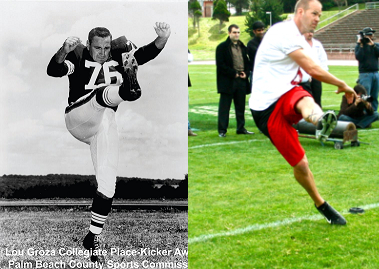
Left: Kickers in the mid-1900s kicked from straight on, with field goal makes traveling 40 yards.
Right: Modern day kickers have a more rounded kick, with field goal makes traveling 60 yards.
Conclusion: Straightening the right leg allows for a greater hip & shoulder turn and creates space for the hands to move inward, creating rotational power. Field goal kickers figured out the benefits of rotational power as seen when their kicking motions shifted from straight on to more rounded like a soccer player’s kick.
Power Source: Changing of Spine Flexion and Extension

Left: The high jumper remains in forward flexion (bent over) and is limited as to how high he can jump.
Right: The high jumper moves from forward flexion (just before he jumps off the ground) to extension (pictured) and can jump many feet higher.

Left: The golfer’s hips have not moved much laterally on the downswing, leaving the hips back and the golfer still in some forward flexion at the finish. The golfer may have come close to “staying in his posture” he had at address.
Right: The golfer’s hips have moved laterally towards the target and then up. The golfer has used power by pushing off the ground. In a complementary move, he has also moved from forward flexion to extension in the finish. The golfer has moved out of the posture he had at address but his inclination to the ground is similar due to his right side bend.
Conclusion: Another aspect for power is the changing flexing, extending, and side bending of the spine during the swing. This is one of the necessary components for turning the shoulders in a circle. It serves as a big source of power in conjunction with proper hip movement. Throughout time the high jumper also realized the power associated with moving from flexion to extension during his jump and shifted his motion to utilize that power source.
There are many other ways power is generated in the Stack & Tilt® system. Today I wanted to touch on these two topics because they seem to be sources that are new to or different than what some people might initially picture would happen during the golf swing. These aspects of power are conducive for playing the game of golf; they promote (1) hitting the ball far enough to golf effectively and (2) with a predictable curve.
Nicely stated Sara. Great read! Thanks for sharing.
Very well researched, thought out, and written. The photos were very credible and very much added to the post! Great job ! Thanks for sharing!
That is very interesting! Well written and easy to follow. Great job Dickie!
Excellent job Sara. Hopefully lots of ‘lightbulb’s went off when reading this!
Nice writing, just a thought might be interesting to compare like for like, top professional against recreational amateur! ?
This is a great article for those who do not understand how S&T works.
Great job Sara.
Well done Sarah! Clear and concise; two elements which are necessary to learning. Keep up the good work!
Great article Sara, clearly you’ve put a good amount of effort into it, I hope it helps golfers reduce their handicaps!
Nice one Sarah, the more people learn of extremely useful concepts the better!! keep it up #mainstream 🙂
Hands close to the body creates speed. Great article.
Very well-written article Sara! Great to see the correct information getting to the masses.
Sarah, tremendous explanation with great photos to distinguish the differences, the Stack & Tilt Pattern is so misunderstood and especially the extension piece coupled with the left tilt and turning in a circle. It goes without saying the inward path of the hands is crucial as well. imply a great article. Congrats,
Great Job Sara! A good post and I intend to share.
Sara,
Very well written, easy to follow and understand. IMO this is how this program should be explained to people. Great pictures, nice job.
Spot on!!